TripSync
One link to plan any group trip.
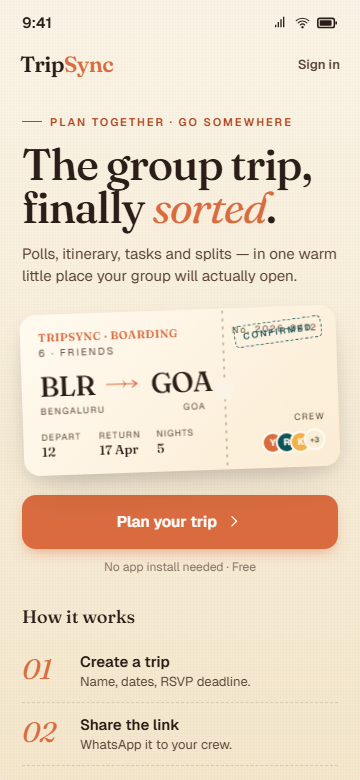
The first screen a new member sees when the organizer shares the trip link — designed to communicate the value prop in one headline.
- →Names the exact problem: no more scattered WhatsApp chaos
- →Single CTA — no account needed just to see what's happening
- →Trip name and organizer visible upfront so it feels personal
TripSync was built after 16 user interviews revealed that group travel's real blocker isn't booking — it's getting people to commit, align on budget, and coordinate without burning out one person. I replaced the scattered stack of WhatsApp, Sheets, and Splitwise with a single link that handles everything from RSVP to settlement.
Why every group trip has one exhausted person
In 14 of 16 interviews, a single person handled everything: research, booking, budgeting, coordination, and conflict resolution. The organizer often had the worst trip experience because they were project-managing instead of relaxing. Existing tools don't distribute this burden — they concentrate it further by giving the organizer more to manage.
The commitment gap no tool was solving
Groups lose two-thirds of their members between 'I'm interested' and 'I've committed.' There's no formal mechanism to capture commitment. People say yes on WhatsApp, then go silent. Every organizer I interviewed invented their own workaround — non-refundable advances, Zoom calls, central funds. Three people, three solutions, one problem. Until commitment is locked, no downstream planning is reliable.
16 interviews, 19 pain points, 5 that matter
I conducted 16 interviews over 4 days across Pune, Bangalore, Mumbai, Delhi, Varanasi, and Boston. Ages 23–40, covering active organizers, passive travelers, execution-willing contributors, and family planners. I identified 19 pain points and prioritized them on two dimensions: severity and solvability. Five scored P0 Critical and form the minimum scope a product must address to be genuinely useful.
The 5-layer architecture
Organizer shares a link. Each member taps, signs in with Google, and RSVPs. Live status board shows who's confirmed, pending, or out. Auto-email reminders go to non-responders before the deadline.
Anonymous budget slider surfaces the group's overlap range. Structured polls replace chaotic WhatsApp threads. Every decision is logged with status: Proposed, Voting, Decided, Booked.
Organizer assigns tasks to specific members with deadlines and status tracking. Email on assignment, reminder when overdue. The burden distributes instead of piling up.
Quick Split mode: add an expense in 4 taps, no daily limits. Group Fund mode: everyone contributes upfront, treasurer logs against the pool. Settlement summary shows optimized transfers.
One link, always current: confirmed members, dates, plan, budget status, task checklist, expense balances. A member who missed 50 WhatsApp messages taps the link and knows everything in 30 seconds.